
The Government of Punjab has introduced revisions to its pension rules, setting updated guidelines related to early retirement, minimum service duration, and pension benefits for employees in the public sector. These reforms aim to strengthen financial discipline within the system while ensuring that pension funds remain stable and sustainable for both present workers and future retirees.
Table of Contents
| Topic | Updated Rule |
| Voluntary Retirement | Must have 25 years service & age 55 |
| Previous Rule | 25 years service alone was enough |
| Pension Calculation | Based on 36 months’ average pay |
| Commutation Limit | 25% max lump sum allowed |
| Family Pension | Mainly for spouse, special conditions apply |
| Pension Increases | Based on net pension, not compounded |
Stricter Pension Rules for Voluntary Retirement
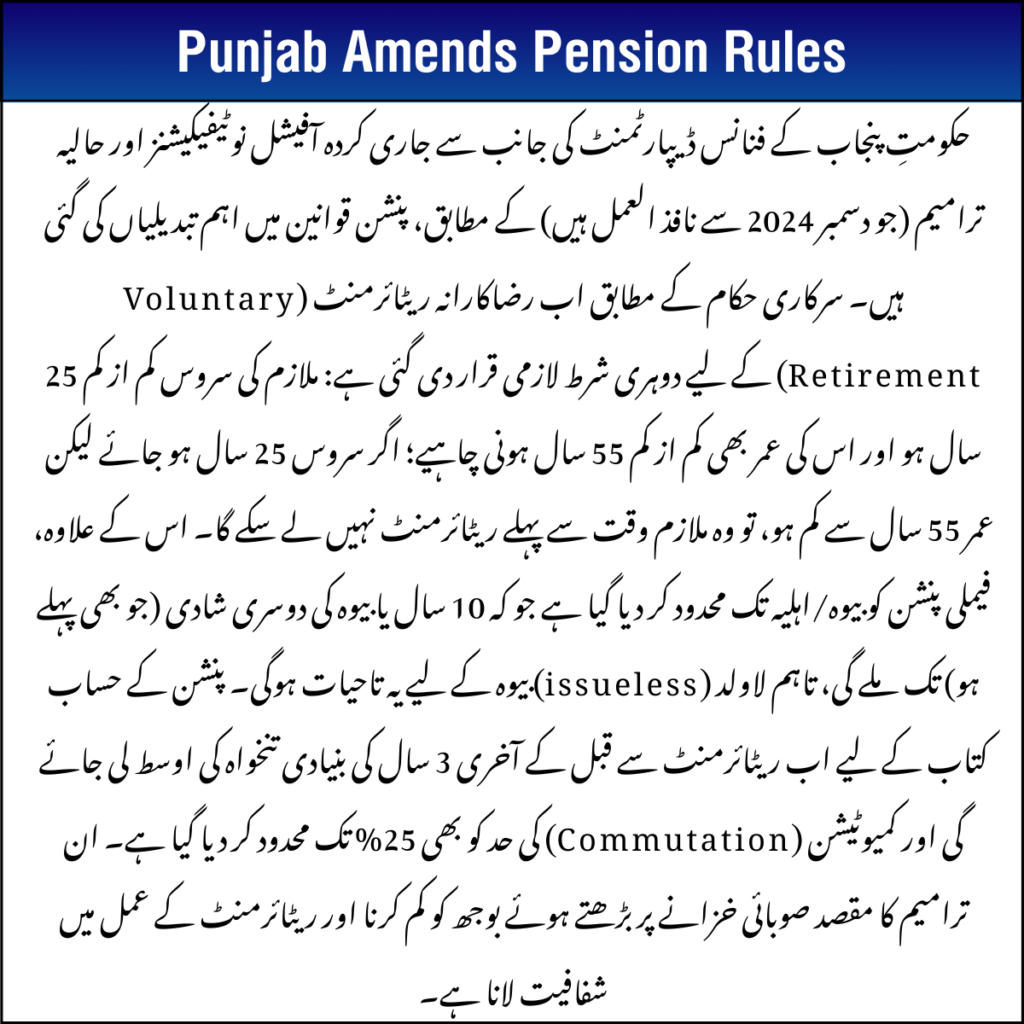
Under the latest amendments, officials can now only retire voluntarily if they satisfy both of these conditions:
- Minimum 25 years of qualifying service
- Must be at least 55 years old
This is a major shift: previously, a government employee could retire after 25 years’ service regardless of age. The amendment now makes age a mandatory second condition, meaning those who achieve 25 years early must wait until 55 to retire.
Pension Calculation: Shift to 36-Month Average
One of the most impactful changes is how pension amounts are now calculated.
Before: Pension was traditionally based on the last drawn basic pay.
Now: Pension will be calculated using the average basic pay from the last 36 months of service.
This change reduces the impact of last-minute promotions or pay hikes aimed at boosting pension payouts. It aims to bring fairness and fiscal discipline to pension benefits.
Commutation Cap: Maximum 25% of Pension
Commutation means taking a lump-sum payment at retirement in exchange for a reduction in monthly pension.
Under the updated rules:
- Pensioners can commute no more than 25% of their total pension as a lump sum.
- The remaining 75% will be paid as monthly pension.
This cap standardizes commutation limits across all government employees.
Family Pension Rules: Who Gets It and How Long
Family pension rules have been clarified as part of the reforms.
Key points:
- Family pension is now primarily available to the spouse (widow/widower).
- Pension continues for 10 years after the spouse’s death unless specific conditions apply.
- If the spouse is issueless (childless), some rules allow pension to continue for life.
- Special provisions protect disabled children, ensuring they receive support beyond the 10-year period.
These rules aim to balance support for dependents with long-term fiscal responsibility.
Annual Pension Increases: New Pension Rules Basis
The pension increase system has been revised:
- Future increases will be calculated as a percentage of the net pension, not as compounded gains.
- This removes automatic compounding of past increases and links growth directly to current pension value.
This change can lead to lower total pension growth over time, but it also promotes transparency and simplifies calculations.
Step-by-Step: What Employees Should Do
Here’s how to assess your own pension situation under the new rules:
- Confirm your years of qualifying government service.
- Check your current age against the new 55-year threshold.
- Review your last 36 months’ basic pay to estimate pension.
- Calculate expected 25% commutation amount.
- Check family pension eligibility for your dependents.
- Understand how annual increases will apply to your net pension.
- Contact official support if you need clarification.
Helpline & Contact
For authoritative guidance and official documents related to the pension rule changes:
- Punjab Finance Department – Official Website: https://finance.punjab.gov.pk/
- Punjab Civil Services Pension Rules Notification (2026) – Available on portal
- Employee Support Helpline: Contact your department accounts/treasury office
Conclusion
The Punjab amendments to pension rules and limits on early retirement options mark a substantial shift in how government pensions are governed. By insisting that early retirees meet both service and age criteria, recalculating pensions on a 36-month average, capping commutation, and adjusting family pension conditions, the government aims for a more disciplined and financially sustainable system.
Government employees and pensioners are encouraged to review these changes carefully and consult official channels before making retirement decisions.
FAQs
Q. What is the new age requirement for voluntary retirement in Punjab?
Employees must now have 25 years’ service and be at least 55 years old.
Q. How will pension be calculated under the new rules?
Pension will be based on the average basic pay of the last 36 months before retirement.
Q. What is the maximum commutation amount allowed?
A maximum of 25% of pension can be taken as a lump sum on retirement.
Q. Who can receive family pension and for how long?
Mainly the spouse (widow/widower) for up to 10 years, with special conditions for disabled children.